
Quick Answer: Tanning patches may work for some people as a gradual sunless glow option, but they should not be judged like instant bronzing mousse. The better question is whether you want a slower, lower-mess routine instead of a traditional DHA self-tanner.
The Short Version
Most people searching “do tanning patches work” are not looking for a chemistry lecture. They want to know whether a small patch can realistically replace their usual self-tanner. The honest answer is: maybe, depending on the patch, your skin, and what you expect from it.
A tanning patch is not the same as rubbing a tinted lotion over your legs and seeing color right away. Products like Celestvéra are designed around a gradual process, which means the payoff is slower but the routine can be much easier.
How Tanning Patches Are Different From Regular Self-Tanner
Traditional self-tanners usually rely on DHA, an ingredient that reacts with the outer layer of skin to create temporary color. That is why the result can smell sweet or biscuit-like, transfer onto sheets, fade unevenly, or look orange on some skin tones.
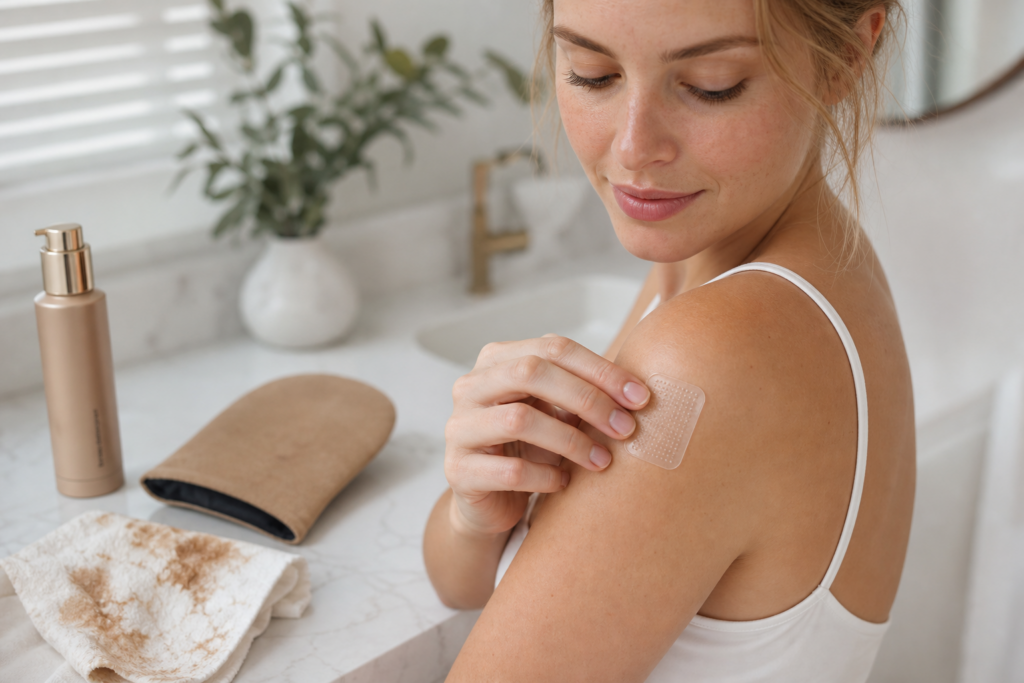
Tanning patches take a different route. Celestvéra uses a microneedle hydrogel patch format, with the product applied to a small area for a short period of time. The appeal is not that you get an instant cosmetic stain. The appeal is that you avoid the full-body application ritual.
What Results Are Realistic?
Realistic expectations matter. A tanning patch is better suited to someone who wants a gradual, natural-looking glow than someone who needs color before an event in three hours. With Celestvéra, the routine is closer to: apply the patch, wait days, then judge the change.
If you are very fair, your result may be subtle. If you already tan easily, the effect may look more obvious. If your skin is reactive, you may need to be more cautious. No sunless tanning product gives the exact same result on every person.
Who May Like Tanning Patches
- People who hate the smell of self-tanner.
- Anyone tired of mitts, streaks, and stained sheets.
- Shoppers who prefer a low-maintenance beauty routine.
- People who want a glow that develops gradually rather than instantly.
Who May Not Love Them
If you want full-body color tonight, choose a bronzing product instead. If you dislike the idea of microneedle patches, even cosmetic ones, this format may not be for you. And if your skin tends to flare up from adhesives or active patches, patch testing is non-negotiable.
Buying Advice
Look for clear instructions, realistic timing, ingredient transparency, and a refund policy. I would be cautious with any tanning product that promises a guaranteed dramatic transformation. Better language is gradual, cosmetic, and individual.
Bottom Line
Tanning patches can make sense if your main problem with self-tanner is the routine. Celestvéra is especially interesting because it leans into that convenience: a short application, no mousse, no mitt, no classic DHA smell. Just remember that slower products need a little patience.
FAQ
Do tanning patches work instantly?
No. Most patch-style tanning products should be viewed as gradual options.
Are tanning patches better than self-tanner?
They are not automatically better. They are better for people who value convenience and dislike traditional self-tanner drawbacks.
Can tanning patches replace sunscreen?
No. They are cosmetic products and should not be used as sun protection.